Linear Dynamical Modeling of RLC Circuits
Modeling and simulation of RC, RL, and RLC circuits as discrete-time linear dynamical systems.
Click Here for the full project page
Overview
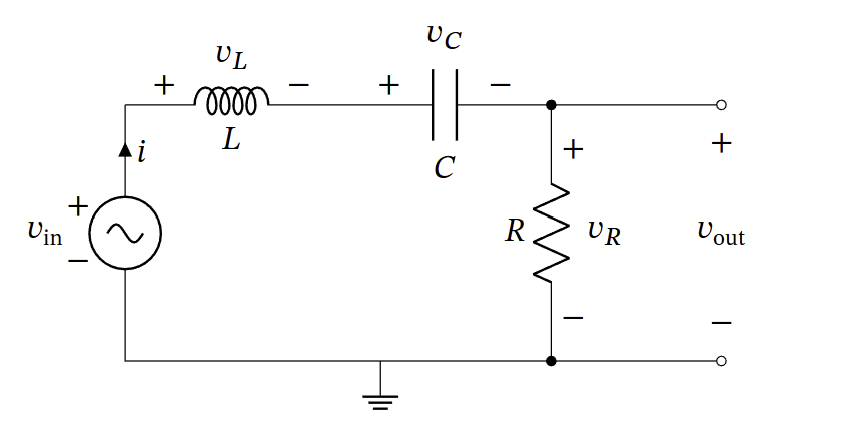
This project presents a systematic approach for modeling and analyzing RC, RL, and RLC electrical circuits using discrete-time linear dynamical systems. The objective was to understand how resistance, capacitance, and inductance influence circuit behavior. Series RLC circuits were modeled using state-space representations derived from Kirchhoff’s Voltage Law and then discretized for simulation in MATLAB. A comprehensive tuning process was developed and applied to design three RLC circuits: a resonator, a sensor, and a filter.
Features
- Linear Dynamical Modeling: Derived and implemented the discrete-time state-space representation for a series RLC circuit
- Circuit Analysis & Derivations: Developed mathematical relationships to calculate component values based on key circuit properties like resonant frequency, damping ratio, and bandwidth
- Component Behavior Study: Simulated and analyzed the complementary transient and steady-state responses of simple RC and RL circuits
- Application-Specific Design: Tuned and simulated three distinct RLC circuit applications:
- Resonator: Designed to produce a stable, sustained oscillatory output
- Sensor: Developed to isolate and amplify a target signal from background noise
- Filter: Tuned to reduce unwanted high and low frequencies while preserving a desired audio range
- Simulation Validation: Demonstrated the effectiveness of discrete-time linear modeling for predicting and designing targeted circuit responses