Computational Optimization of Lens-Based Imaging Systems
Modeling and optimization of a lens-based imaging system using linear algebra and computational ray tracing for reconstruction of simulated light-ray data.
📄 Links
Full paper: Computational Optimization and Selective Reconstruction in Lens-Based Imaging Systems
Github: Repository
🔍 Overview
This project treats an optical imaging system as a linear transformation pipeline. Light rays are represented in matrix form and propagated through:
- Free space
- A convex thin lens
- A sensor plane
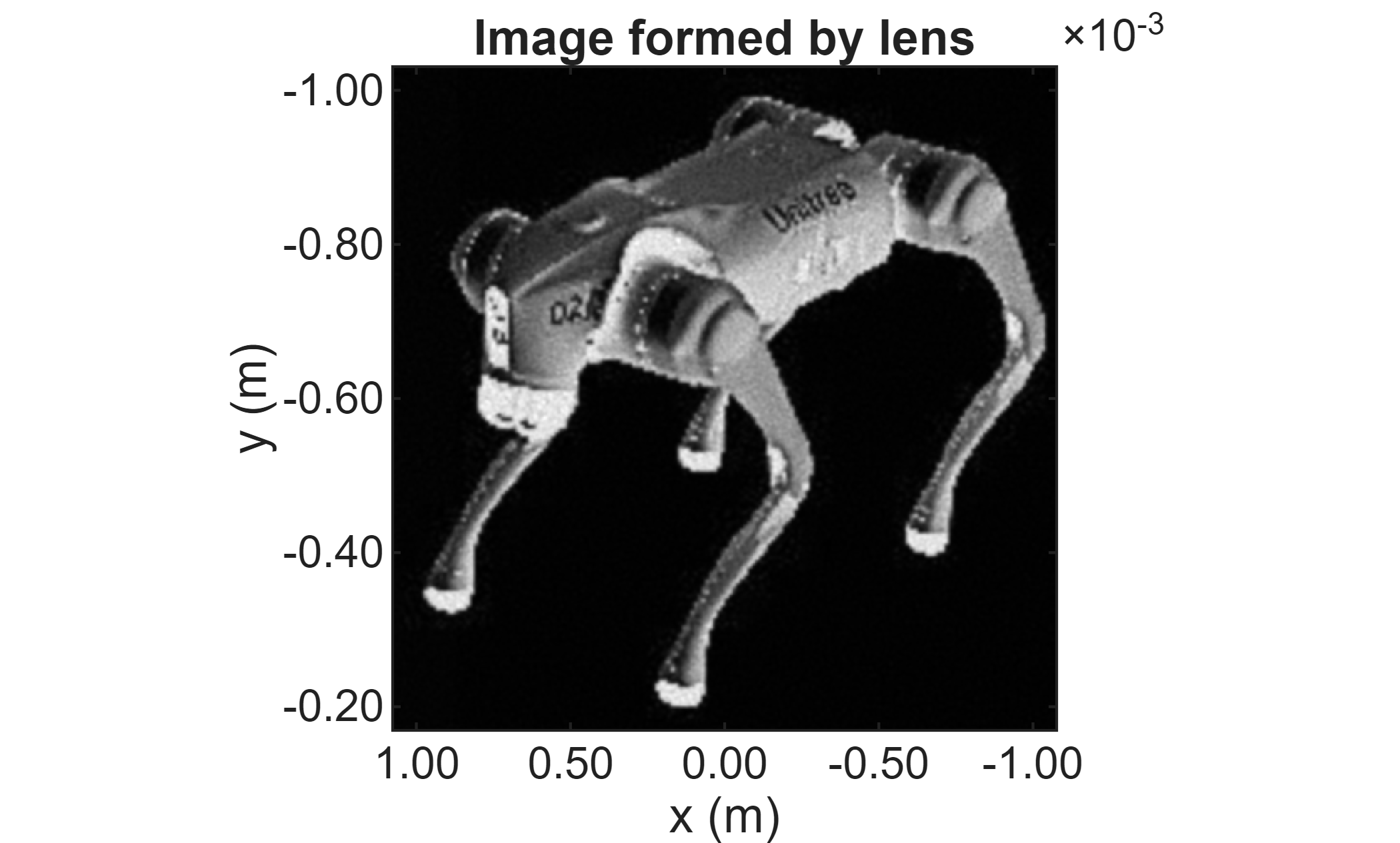
By tuning physical and sensor parameters, the system can focus and reconstruct clear images from overlapping ray data. A structured optimization workflow was used to maximize image sharpness and selectively capture different objects by translating the lens.
Gaussian smoothing was applied as a final post‑processing step to reduce noise while preserving structural details.
✨ Features
🧮 Linear Optical Modeling
- Matrix-based ray tracing through free space and a thin lens
- Rays represented as state vectors transformed via linear system matrices
🎯 Imaging System Optimization
- Numerical sweep to optimize lens-to-sensor distance
- Custom sharpness metric based on edge strength using convolution filters
🖼 Selective Image Reconstruction
- Lateral lens translation isolates rays from different objects
- Enables recovery of multiple distinct images from overlapping data
📐 Sensor & Resolution Tuning
- Sensor width adjusted to properly frame each image
- Pixel count tuned to balance resolution and brightness
🌫 Post‑Processing Enhancement
- 1D Gaussian smoothing filter applied horizontally and vertically
- Reduces noise while preserving edges and structure
🔬 Lens Necessity Validation
- Demonstrated that free-space propagation alone cannot produce focused images
- Verified mathematically and experimentally that a lens is required for ray convergence
🛠 Tools Used
- MATLAB (ray tracing, simulations, parameter sweeps)
- Linear algebra & state-space modeling
- Convolution-based image processing
👨💻 Authors
Rex Paster
Adam Fleischman